Faction Warfare Complexes
Faction Warfare Mechanics
Faction warfare complexes (plexes) are where most fights and most LP happen. Capture them to earn loyalty points and push systems toward flipping for the Minmatar Republic.
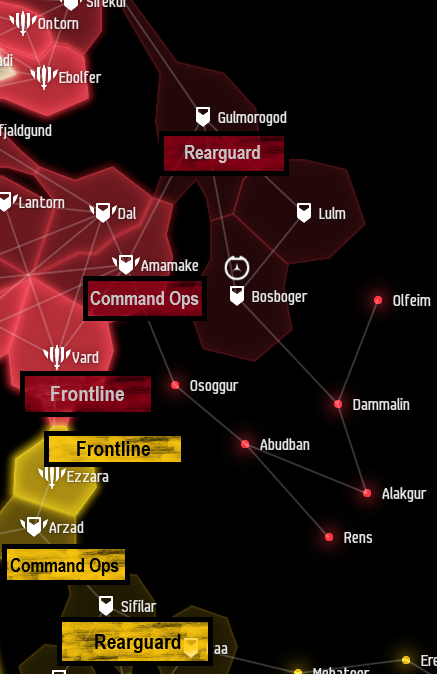
For map colors, system types (frontline / command ops / rearguard), contested vs advantage, and how site names are read, start with Faction Warfare Basics. This guide covers plexing itself: the deadspace pocket, and the LP / victory point tables.
This month in the warzone: Warzone Report.
Basics
Outside the plex
Warping to a plex lands you at an acceleration gate (Open plexes have no gate—you land inside at your warp range).
- Align to the pocket before activating the gate so you don’t sit still on the gate.
- Gate activation range is ~90km. A warp-to-100 may land you just outside range.
- A warp disruptor or scram blocks the gate.
- The gate is collidable—warping to 0 often means bouncing off it when you activate.
- Longer warps are safer: you always land between the gate and your origin, so distant warpins leave more room.
- You can warp to objects on the outside grid.
Inside the plex
- You cannot warp to anything on the grid (objects or fleetmates), even after the site finishes.
- You can always warp out (unless pointed/scrambled); warping back returns you to the acceleration gate.
- Capture radius is 30km; the pocket itself is much larger.
- The central structure has no collision.
Landing beacon
You land within ~3.5km of the landing beacon at a random spot.
- Enable brackets so you can see the beacon.
- The beacon is a large collidable with a small hitbox—rarely sticky.
- Sitting on the beacon minimizes distance to anyone entering.
- Hold the range you want for the next fight relative to the beacon.
- The NPC spawns from the central structure ~8–12km from the beacon.
Landing invulnerability
Anyone already inside sees you before you finish landing and can move on you early.
- Landing ships decelerate to 0 m/s.
- ~10 seconds of invulnerability after landing ends immediately if you do anything other than preheat modules.
- Use that window to decide: burn in, burn out, or hold.
- Reinforcements always land on the beacon—they cannot land on a friendly already inside.
Site Restrictions
Each site name encodes size, ship classification, and how many pilots get a full payout. Anything under the size cap can usually enter.
| Size | Capture time | Maximum ship class |
|---|---|---|
| Scout | 10 min (BSC-1: 5 min) | Frigates and below |
| Interceptor | 10 min | Interceptors only |
| Small | 10 min | Destroyers and below |
| Medium | 15 min | Cruisers and below |
| Moderate | 15 min | Battlecruisers and below |
| Large | 15 min | Battleships and below |
| Open | 15 min | Any ship |
| Classification | Allowed ships |
|---|---|
| BSC | Tech I only |
| NVY | Navy and Tech I |
| ADV | Tech II, Pirate, Navy, and Tech I |
| ELT | Tech III destroyers and below (all ships of that size, including T3s) |
| Payout suffix | Meaning |
|---|---|
-1 |
One pilot receives full payout before rewards split |
-2 |
Up to two pilots receive full payout before rewards split |
-3 |
Up to three pilots receive full payout before rewards split |
-4 |
Up to four pilots receive full payout before rewards split |
-X |
Up to X pilots receive full payout before rewards split |
Example: Minmatar Scout BSC-1 — frigates only, Tech I only, one full payout before splitting.
Other rules:
- The payout number is not a hard entry cap—extra pilots can enter, but LP splits past the cap.
- Smaller ships can enter larger plexes (e.g. destroyers in a Large).
- T3 destroyers count as one size larger (Medium ADV+). T3 cruisers only fit Large ADV and Open.
Where to plex: Frontlines pay the most LP and VP. Command Ops and rearguards pay less, but are quieter and sometimes useful for surprise contest / advantage work. See Faction Warfare Basics → Systems.
Site rewards
Loyalty points depend on site type and system type.
| System type | LP multiplier |
|---|---|
| Frontline | 1.5× base |
| Command Operations | 1.0× base |
| Rearguard | ~0.01× base (almost nothing) |
| Site | Full-payout pilots | Base LP | Frontline LP |
|---|---|---|---|
| Scout BSC-1 | 1 | 7,500 | 11,250 |
| Scout NVY-1 | 1 | 10,000 | 15,000 |
| Scout NVY-2 | 2 | 12,500 | 18,750 |
| Small Interceptor-1 | 1 | 25,000 | 25,000 |
| Small NVY-1 | 1 | 15,000 | 22,500 |
| Small NVY-2 | 2 | 18,750 | 28,150 |
| Small ADV-1 | 1 | 17,500 | 26,250 |
| Small ADV-2 | 2 | 20,000 | 30,000 |
| Contested Field Research Facility | up to 5 | 30,000 | 45,000 |
| Medium NVY-1 | 1 | 20,000 | 30,000 |
| Medium NVY-3 | 3 | 25,000 | 37,500 |
| Medium ADV-1 | 1 | 25,000 | 37,500 |
| Medium ADV-3 | 3 | 30,000 | 45,000 |
| Moderate NVY-3 | 3 | 35,000 | 52,500 |
| Large NVY-1 | 1 | 25,000 | 37,500 |
| Large NVY-4 | 4 | 30,000 | 45,000 |
| Large ADV-1 | 1 | 25,000 | 37,500 |
| Large ADV-4 | 4 | 30,000 | 45,000 |
| Open | up to 5 | 30,000 | 45,000 |
| Battlefield | up to ~30 | 150,000 | 150,000 |
Notes:
- Multi-pilot sites pay the listed LP to each pilot up to the cap; past that, the pool splits.
- Solo (
-1) versions of a size usually pay a bit less than the multi-pilot variant of the same size/class. - Grouping into a
-2/-3/-4site is often better ISK than splitting a-1. - Small Interceptor-1 is listed at the same LP in both columns because it pays frontline-like rates while spawning in Command Ops.
CCP is always tweaking these values—numbers above may have changed recently.
Site impact
Capturing a plex adds victory points toward contested %. A system needs 75,000 VP to hit 100% and become vulnerable. Advantage increases VP per capture—see Faction Warfare Advantage.
| Site | Victory points | ≈ Contested % (no advantage) | Capture time |
|---|---|---|---|
| Scout NVY | 25 | 0.03% | 10 min |
| Scout BSC-1 | 50 | 0.07% | 5 min |
| Small NVY | 50 | 0.07% | 10 min |
| Small ADV | 75 | 0.10% | 10 min |
| Small Interceptor-1 | 150 | 0.20% | 10 min |
| Medium NVY | 150 | 0.20% | 15 min |
| Medium ADV | 175 | 0.23% | 15 min |
| Contested Field Research Facility | 300 | 0.40% | 10 min |
| Large NVY | 250 | 0.33% | 15 min |
| Large ADV | 300 | 0.40% | 15 min |
| Moderate NVY-3 | 600 | 0.80% | 15 min |
| Open | 350 | 0.47% | 15 min |
| Battlefield | 2,000 | 2.67% | ~30–45 min |
Larger sites move contested much faster. When both sides are pushing the same system, expect the real fight over Mediums, Larges, Moderates, Opens, and Battlefields.
System Capture
At 100% contested the infrastructure hub becomes vulnerable. Push a bit past 100% before committing to the siege—defenders will try to grind contested back down.
Destroying the i-hub flips the system and resets victory points to 0.
Additional Resources
- Faction Warfare Basics
- Faction Warfare Advantage
- Faction Warfare Battlefields
- New Player Fleet Guide
- Guides index
- Amarr vs Minmatar Dotlan
- Patch Notes — Version 21.05 (victory point rebalance)
- Patch Notes — Version 22.02 (multi-pilot payout caps)
- Cradle of War: Expansion Notes (new sites and battlefield LP)